Image
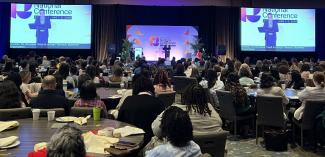
Grantmakers for Effective Organizations (GEO), is a membership organization working to transform philanthropic culture and practice from within, with racial equity at the center. This year's conference brought together grantmakers, nonprofit leaders, and community advocates from across the country to explore what it means to build a more equitable future. Dana was invited to open the conference as part of a plenary featuring nonprofit and community leaders from across the Northeast, each offering a vignette grounded in place, local wisdom, and the realities of leading with purpose in this moment.
Here's what Dana said:
Sometimes it really is small gestures that have the biggest impact.
At the end of every week of our camp program, youth exchange "heck yeahs," - little notes of love, affirmation, and gratitude.
A few summers ago, a young person handed me this:
"I have never in my life met an adult trans person. You are so cool, kind, and such a role model. Your family is beautiful, and it made me realize I could have a beautiful family too someday."
I want us to just sit with that for a moment.
“I have never in my life met an adult trans person.”
They’d made it to adolescence without ever seeing their future reflected back at them. Not in a teacher. A neighbor. Nowhere.
That is not just a gap in representation. It's what rural isolation does to queer and trans young people. It doesn't just limit what they see, it limits what they believe is possible. And that right there is quite literally a recipe for disaster we see playing out in real time.
I grew up on the Upper West Side of Manhattan. I am, at my core, a city kid — shaped by density, convenience, the beautiful anonymity of a crowd, bodegas, and subway cars full of strangers sharing a city.
But I ended up in Vermont.
Like many queer and trans people before me, I needed to leave home to become myself. And what I learned over the past thirty years is that while the location drew me in, it was the place that kept me there.
Place: what happens when people stay long enough to make meaning, and build responsibility to one another.
So the place I lead is Outright Vermont, the statewide organization working alongside LGBTQ+ young people, their families, and communities. Vermont, one of the whitest, most rural states in the country, where the gap between our progressive reputation and what it's actually like to live as a queer or trans person are dangerous distances apart… and that’s where work lives.
When people ask me how I’m doing these days, I usually respond with, “I’m not bored!” What can I say? I pride myself on being authentic.
Organizationally, we are on an audacious trajectory from scrappy to mighty, because that's what youth need. I won’t rehash the statistics here. Let’s just say we have a lot to shift in order to be the sanctuary state we are deemed to be.
If you are reading this, you all know that trans and queer young people are living through deeply coordinated, well-funded legislative attacks on every aspect of their lives, from healthcare and legal rights, to basic access to safe schools, sports, and bathrooms. These attacks are a strategy. And they certainly land hardest on young people already carrying the most: Black and brown trans youth navigating racism and transphobia in the same breath, queer youth with disabilities whose needs are multiply overlooked, undocumented youth for whom visibility carries real danger, Indigenous youth whose understandings of gender and belonging were targeted long before this current political wave.
Our mission is to build a Vermont where all LGBTQ+ youth have hope, equity, and power, and we mean all youth. Our youth organizers working for trans visibility are the same people organizing for housing and climate justice, disability rights, and education equity. Their priorities are intersectional because they see the truth that systems were designed to refute. They get the path forward. We need to catch up.
In rural communities, isolation is not incidental. It is structural. When support systems are distant or absent, it is relationships that carry the weight of care. And when those relationships cease to exist, rarely is there a second system waiting to catch the loss.
That’s an infrastructure failure, expressed through human experience, and carried most acutely by our communities, who themselves navigate a particular paradox: invisible and hypervisible all at the same time.
Queer and trans young people are invisible in the data that drives funding decisions. Invisible in policy debates happening in the state capitals they've never been invited to visit. Invisible in the devastating sense that a teenager can make it to adolescence without ever meeting an adult - or peer - who shares their identity.
And yet hypervisible in the sense that in a small town, there is no crowd to disappear into. Coming out often means everyone - your teachers, your pastor, your neighbors, the person who runs the feed store - is all up in your business, without your consent. There is no subway car where you get to just be another person moving through the city. In rural spaces, anonymity isn't an option.
Minority Stress Theory is clear: there is nothing inherently harmful about being on the margins. The harm youth experience comes from chronic exposure to environments shaped by the accumulation of bias. But for youth living rurally, they carry that weight without the buffers that density provides.
And when they do seek support, access to care can be as spotty as our rural cell service. There may be one provider in any given town, if that. And regardless, let’s not conflate access to care with access to affirming care. In rural Vermont, the gap between them can be vast.
Where isolation is the default, community is the intervention.
And it’s painstakingly clear what happens when we don't get there in time.
Trigger warning: this next section includes discussion of suicide, not because I want us to stay fixed on that narrative, but because it’s impossible not to bring it in to the current picture.
On the heels of finishing writing these remarks, two trans and nonbinary youth in Vermont died within the same week.
One had been planning to attend our summer camp for the first time in July. I know they loved Japanese pop music, anime, their dog, and being outside. I know they had stopped going to school in person because it was too much to navigate. But they kept showing up for their gender and sexuality alliance group, because there, they felt a sense of belonging. Because that was their place.
I spoke to their parent the other week, and I have been carrying that family, that community, and that conversation with me ever since.
These stakes are far from abstract.
This young person never got to sit around a campfire with their people. Never got to open their own heck yeah bag. Never had what they needed to believe life was possible for them, too.
The distance between the youth who got a week of community and the youth who never did is not fate. It is the presence or absence of the conditions we all need to succeed. A place that says: you exist, you matter, there is room for you here, just as you are.
That is what we are building. And that is why philanthropy's appetite for risk needs to match the urgency of what our communities are facing. Shout out to multi-year, trust-based investments, not as a nice-to-have, but rather as the standard. Or dare I say, minimum.
As a trans person, I happen to have a lot of practice holding contradictions: the body I was given and the self I knew, the world as it was and the world I needed it to become. Grief and joy in the same breath. Fear and forward motion.
And it's precisely my trans identity that taught me how to hold all of this without being flattened by it. Well, minus the top surgery, of course. See what I did there? It turns out that practice of holding contradictions is really good leadership training.
Because this moment asks of us the capacity both to hold the hard truths and keep moving. Young people don't need us to pretend it isn't hard. They need us to show them what it looks like to stay.
They need leaders who can say: this is real, we are still here, and we are not done. They need adults who follow their lead, not the other way around. The adultist assumption that young people need to be managed rather than trusted is real, and it shows up in our sector more than we like to admit.
At Outright, we work to dismantle it from the inside out. Because we know that when young people move from recipients of care to leaders in their communities, their mental health outcomes improve.
That is not an anecdote. That is evidence.
We use queerness as a power, believing no construct is too sacred to be questioned, torn down, or rebuilt with gorgeous flair. We believe in youth to the front — not as a catchphrase, but as a structural commitment.
Young people are not the future of this work. They are its present. And they need to know places exist for them year-round.
Which is why when we thought we had before us a once-in-a-blue moon opportunity, we purchased a 148-acre former Boy Scouts camp in central Vermont, thanks to an unlikely – and then new to us - partnership with the Vermont Land Trust and Housing and Conservation Board. Turns out it was once in a lifetime.
The poetic justice here is kind of amazing. I mean, you can't make this stuff up! A camp that once excluded LGBTQ+ people - that treated queerness as a threat to be contained - is on its way to becoming a sanctuary for queer and trans kids.
It's so much more than acreage. It's reclaiming the notion that young people deserve expansive space, to see bold possibilities, to be in nature, in their bodies, to breathe.
And if we can build this in Vermont, with rigor, with a queer ethic, with an absolute refusal to leave anyone outside the frame, then we are building proof of concept that queer places are possible everywhere.
Rural spaces are fertile ground for real change. Not because it's easy. Because the distance between our values and our realities is honest, and we have just the right mix of gumption and will to close that gap.
We regularly reflect on what it means to queer the work, knowing the old ways will never produce liberated outcomes. And now I'd be slacking on this here job if I didn't invite you into a similar inquiry:
Are the values driving your philanthropy as bold as the change you want to see in the world? What are you willing to give up to make it so?
We all know the organizations doing the most consequential work, rooted in community, alongside the people most targeted, are often the least legible to traditional philanthropic frameworks. The metrics aren't always clean. The outcomes are sometimes messy before they're clear. And yet we are closest to what communities actually need, building what young people have been pointing toward long before systems were prepared to hear it.
As a sector, we are also over-invested in responding to harm and under-invested in preventing it. Belonging is not a program outcome. It is a primary mental health intervention. And it requires the kind of flexible, sustained, trust-based funding that allows organizations to respond to what young people are actually experiencing in real time.
The funders transforming this work are not only the ones writing the largest checks. They are the ones willing to extend trust before certainty arrives. To share risk. To stay in relationship long enough to see what emerges.
This is a community of people and institutions with the power to shape what becomes possible, not just through the size of your investments, but through how you invest. Who you trust. How long you stay. Whose leadership you legitimize before it arrives fully proven.
Wherein adrienne maree brown urges us to find the conversation that only these people, in this moment, can have — I dare us to consider: What would it look like to fund as if we believed, fully, that liberation is possible for each and every one of us?
That young person who wrote me that heck yeah note didn't just need me to exist. They needed to see that existence could be full. Joyful. That it could include a beautiful family, a meaningful life, a future worth building toward.
And the young person whose parent called to cancel their camp registration — they needed that too. July couldn’t come soon enough.
That is the cost of what adults and institutions have not yet built.
And yet — across every identity, every rural town, every margin this sector has historically underserved — young people are not waiting for us to get comfortable. They are building anyway.
Let’s meet them there, shall we?
Thank you.